
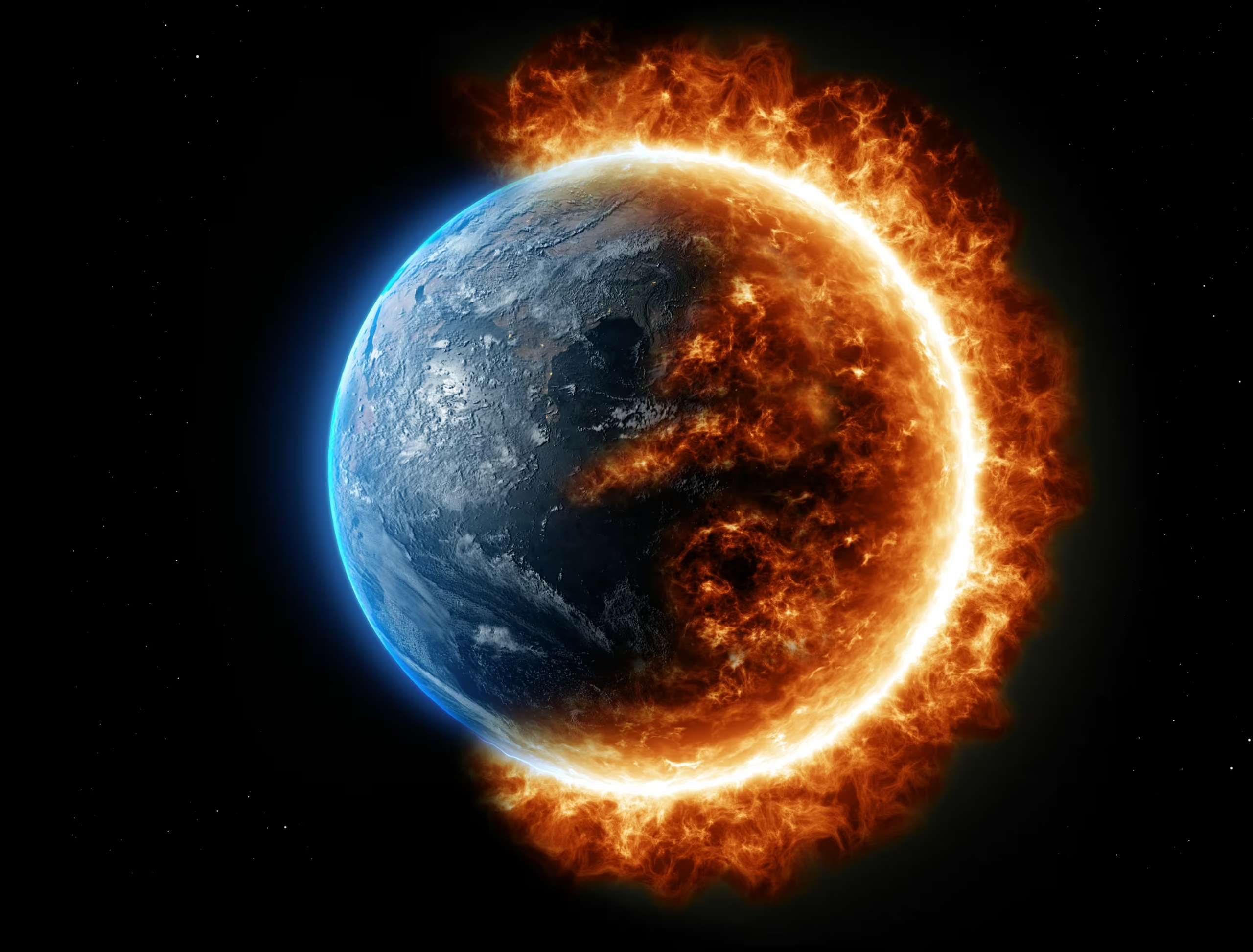
Global warming is a gradual increase in the earth’s temperature generally due to the greenhouse effect caused by increased levels of carbon dioxide, CFCs, and other pollutants.
Global warming is the phenomenon of a gradual increase in the temperature near the earth’s surface. This phenomenon has been observed over the past one or two centuries. This change has disturbed the climatic pattern of the earth. However, the concept of global warming is quite controversial but the scientists have provided relevant data in support of the fact that the temperature of the earth is rising constantly.
There are several causes of global warming, which have a negative effect on humans, plants and animals. These causes may be natural or might be the outcome of human activities. In order to curb the issues, it is very important to understand the negative impacts of global warming.
Natural Causes of Global Warming
Volcanoes
Volcanoes are one of the largest natural contributors to global warming. The ash and smoke emitted during volcanic eruptions goes out into the atmosphere and affects the climate.
Water Vapour
Water vapour is a kind of greenhouse gas. Due to the increase in the earth’s temperature, more water gets evaporated from the water bodies and stays in the atmosphere adding to global warming.
Melting Permafrost
Permafrost is frozen soil that has environmental gases trapped in it for several years and is present below Earth’s surface. It is present in glaciers. As the permafrost melts, it releases the gases back into the atmosphere, increasing Earth’s temperature.
Forest Blazes
Forest blazes or forest fires emit a large amount of carbon containing smoke. These gases are released into the atmosphere and increase the earth’s temperature resulting in global warming.
Global warming is related to the more general phenomenon of climate change, which refers to changes in the totality of attributes that define climate. In addition to changes in air temperature, climate change involves changes to precipitation patterns, winds, ocean currents, and other measures of Earth’s climate. Normally, climate change can be viewed as the combination of various natural forces occurring over diverse timescales. Since the advent of human civilization, climate change has involved an “anthropogenic,” or exclusively human caused, element, and this anthropogenic element has become more important in the industrial period of the past two centuries. The term global warming is used specifically to refer to any warming of near-surface air during the past two centuries that can be traced to anthropogenic causes.

Diseases transmitted by mosquitoes include some of the most widespread worldwide illnesses such as malaria and viral diseases. Tick-borne diseases have increased in the past years in cold regions, because rising temperatures accelerate the cycle of development, the production of eggs, and the density and distribution of the tick population. The areas of presence of ticks and diseases that they can transmit have increased, both in terms of geographical extension than in altitude. In the next years the engagement of the health sector would be working to develop prevention and adaptation programs in order to reduce the costs and burden of climate change.
Climate change scenarios include a change in distribution of infectious diseases with warming and changes in outbreaks associated with weather extreme events. After floods, increased cases of leptospirosis, campylobacter infections and cryptosporidiosis are reported. Global warming affects water heating, rising the transmission of water-borne pathogens. Pathogens transmitted by vectors are particularly sensitive to climate change because they spend a good part of their life cycle in a cold-blooded host invertebrate whose temperature is similar to the environment. A warmer climate presents more favorable conditions for the survival and the completion of the life cycle of the vector, going as far as to speed it up as in the case of mosquitoes.
The change in climatic conditions is a result of global warming. The burning of fossil fuels, cutting down of trees etc. causes the temperature of the earth to increase. High temperature changes the weather patterns, causing the dry areas to get drier and wet areas to get wetter. Thus, increasing the frequency of disasters like floods, droughts etc.
Man-made Causes of Global Warming
Chlorofluorocarbon
With the excessive use of air conditioners and refrigerators, humans have been adding CFCs into the environment which affects the atmospheric ozone layer. The ozone layer protects the earth surface from the harmful ultraviolet rays emitted by the sun. The CFCs have led to ozone layer depletion making way for the ultraviolet rays, thereby increasing the temperature of the earth.
Deforestation
Plants are the main source of oxygen. They take in carbon dioxide and release oxygen thereby maintaining environmental balance. Forests are being depleted for many domestic and commercial purposes. This has led to an environmental imbalance, thereby giving rise to global warming.
Industrial Development
With the advent of industrialization, the temperature of the earth has been increasing rapidly. The harmful emissions from the factories add to the increasing temperature of the earth.
Use of Vehicles
The use of vehicles, even for a very short distance results in various gaseous emissions. Vehicles burn fossil fuels which emit a large amount of carbon dioxide and other toxins into the atmosphere resulting in a temperature increase.
Effects of Global Warming
Following are the major effects of global warming:
Rise in Temperature
Global warming has led to an incredible increase in earth’s temperature. Since 1880, the earth’s temperature has increased by ~1 degrees. This has resulted in an increase in the melting of glaciers, which have led to an increase in the sea level. This could have devastating effects on coastal regions.
Threats to the Ecosystem
Global warming has affected the coral reefs that can lead to the loss of plant and animal lives. Increase in global temperatures has made the fragility of coral reefs even worse.
Climate Change
Global warming has led to a change in climatic conditions. There are droughts at some places and floods at some. This climatic imbalance is the result of global warming.
Spread of Diseases
Global warming leads to a change in the patterns of heat and humidity. This has led to the movement of mosquitoes that carry and spread diseases.
High Mortality Rates
Due to an increase in floods, tsunamis and other natural calamities, the average death toll usually increases. Also, such events can bring about the spread of diseases that can hamper human life.
Loss of Natural Habitat
A global shift in the climate leads to the loss of habitats of several plants and animals. In this case, the animals need to migrate from their natural habitat and many of them even become extinct. This is yet another major impact of global warming on biodiversity.
global warming is one of the most pressing challenges of our time. Its effects are already visible, and without urgent action, they will intensify in the coming decades. By working together and adopting sustainable practices, humanity can slow down global warming and protect the planet for future generations.
Local vegetation cover impacts how much of the sunlight gets reflected back into space (albedo), and how much heat is lost by evaporation. For instance, the change from a dark forest to grassland makes the surface lighter, causing it to reflect more sunlight. Deforestation can also modify the release of chemical compounds that influence clouds, and by changing wind patterns. In tropic and temperate areas the net effect is to produce significant warming, and forest restoration can make local temperatures cooler. At latitudes closer to the poles, there is a cooling effect as forest is replaced by snow covered (and more reflective) plains. Globally, these increases in surface albedo have been the dominant direct influence on temperature from land use change. Thus, land use change to date is estimated to have a slight cooling effect.
As temperatures rise, weather patterns become more unpredictable and extreme ,One of the most visible effects of global warming is climate change. Many regions experience more intense heatwaves, prolonged droughts, and stronger hurricanes. Rainfall patterns shift, causing severe flooding in some areas and water scarcity in others. Farmers face reduced crop yields due to changing seasons and weather irregularities, which in turn threatens food security around the world. These extreme weather events not only endanger lives but also disrupt agriculture, damage infrastructure, and strain national economies.
Greenhouse gases are transparent to sunlight, and thus allow it to pass through the atmosphere to heat the Earth’s surface. The Earth radiates it as heat, and greenhouse gases absorb a portion of it. This absorption slows the rate at which heat escapes into space, trapping heat near the Earth’s surface and warming it over time.